Research Projects
Brain Tumor Classification and
Segmentation
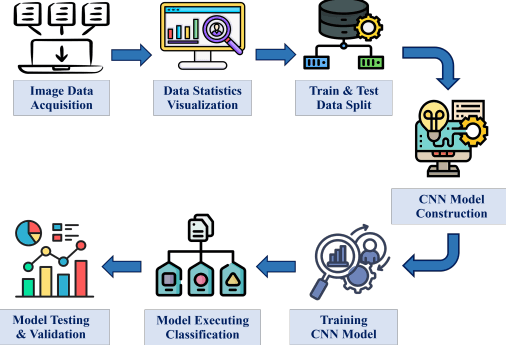
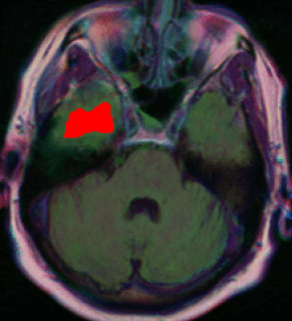
The proposed Brain MRI segmentation model is a lightweight, two-stage deep learning framework designed for the efficient detection and segmentation of Lower-Grade Gliomas (LGG) from MRI images. The model employs a basic encoder-decoder architecture inspired from UNet while emplying depth-wise convolutions as backbone for high-efficiency feature extraction. It also integrates Attention into the skip connections to filter redundant noise and emphasize tumor-relevant features. Operating through a cascaded pipeline, the system first classifies the presence of a tumor before performing pixel-wise segmentation, significantly reducing unnecessary computational overhead. Experimental results demonstrate state-of-the-art performance, achieving a mean Dice score of 0.95 and a mean IoU of 0.91, while maintaining a significantly lower parameter count compared to traditional models like UNet.
NLP Chakma Sentiment Analysis
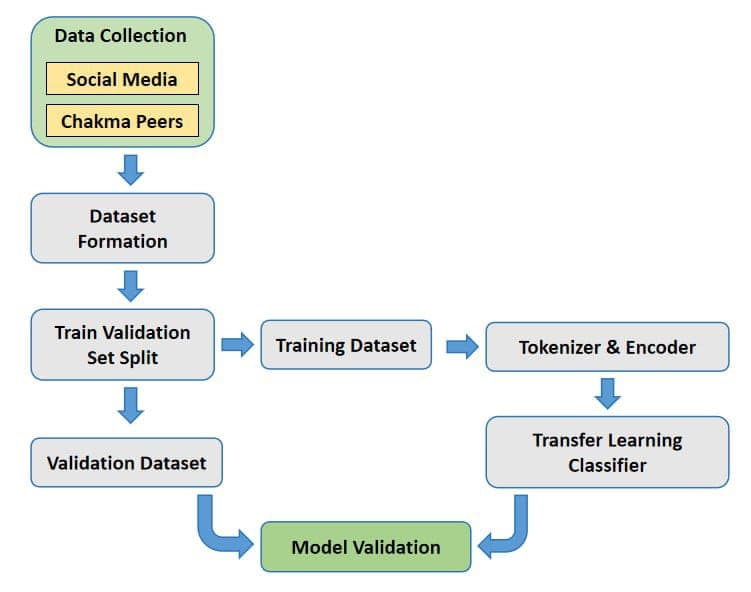
Natural Language Processing (NLP) is one of the trending topics in AI. Text classification, text completion, and sentiment analysis have been carried out for various languages, including English, Bengali, and Spanish. However, there are still languages where the potential of NLP is unexplored. The Chakma dialect, spoken by a significant ethnic group in the Chittagong Hill Tracts of Bangladesh, is one such area. This study makes a novel contribution by assessing sentiment classification in the Chakma language for the first time. A Chakma language dataset is formed by collecting some frequently used texts from social media networks and Chakma peers. It contains more than 8000 text samples with three different labels: positive, negative, and neutral. To classify this low-resource language effectively, several Bert-based classifiers are fine-tuned and validated using accuracy metrics and confusion metrics. Among the classifiers, bert-base-uncased obtained 0.85 accuracy and 0.46 validation loss, surpassing the others. This study will work as a pioneer for other low-resource ethnic languages that are still unexplored in this domain.
Refined Segment Anything Model
Currently, I am analyzing the Segment Anything Model (SAM) to replace its traditional mask decoder with a dedicated LLM-based reasoning engine and introducing a multi-modal prompting strategy. This approach may shift the segmentation process from simple geometric matching to a high-level interpretive task, where the LLM decoder can process complex clinical narratives—such as specific radiological instructions or pathological context to resolve ambiguities in diffuse tumor boundaries. By integrating linguistic reasoning directly into the decoding phase, the model can adaptively refine masks for critical medical images like MRI, CT scan etc.
Real-time monitoring with Computer Vision
Real-time monitoring and surveillance with Computer Vision is one of my current projects in collaboration of IIUC. I am guiding a group of students on project titled ESP-32 cam based robotic car surveillance and object detection with OpenCV and YOLOv26. Some extra features are to be added to fine-tune the current YOLO model. A comparison between YOLOv8, v11 and v26 will also be performed for making a robust result summary.
LCG Attention for Load Forecasting
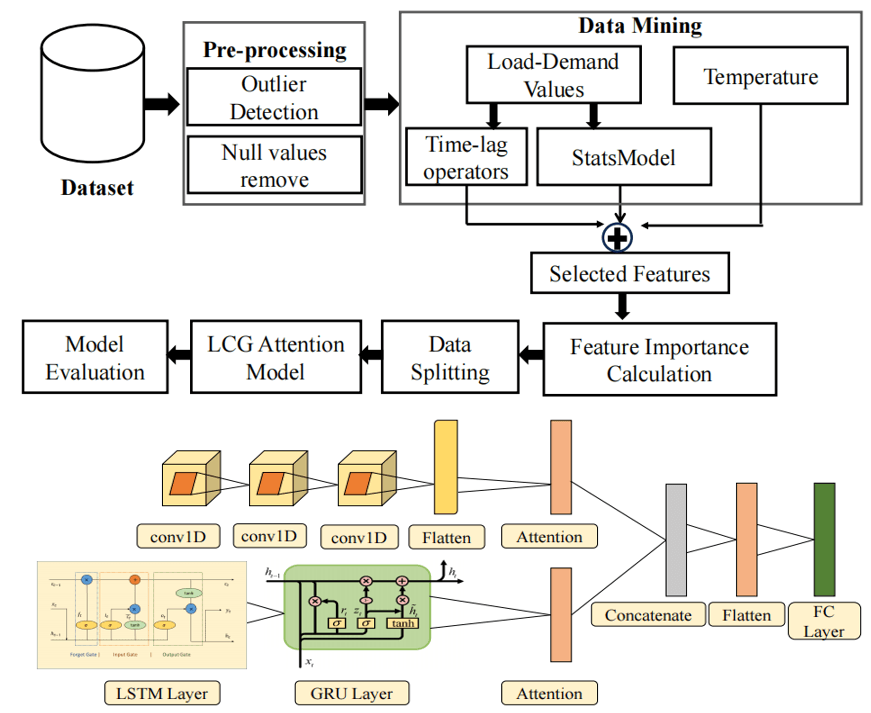
LCG Attention model is a novel deep neural network which fuses an attention enhanced CNN layer with another attention enhanced LSTM. The model is validated using historical load data from the Chattogram district and other benchmark public datasets. Results show that it outperforms several state-of-the-art methods, setting a newbenchmark for regional short-term load prediction. It is primarily benchmarked for load forecasting, a time-series application and can be pioneered for other forecasting methods and NLP. Overall methodology involves data preprocessing, increasing the number of features by using time-lag and statsmodels, feature importance calculation, data splitting, LCG Attention model, and model evaluation, respectively.
Publication Url
Credit card fraud detection
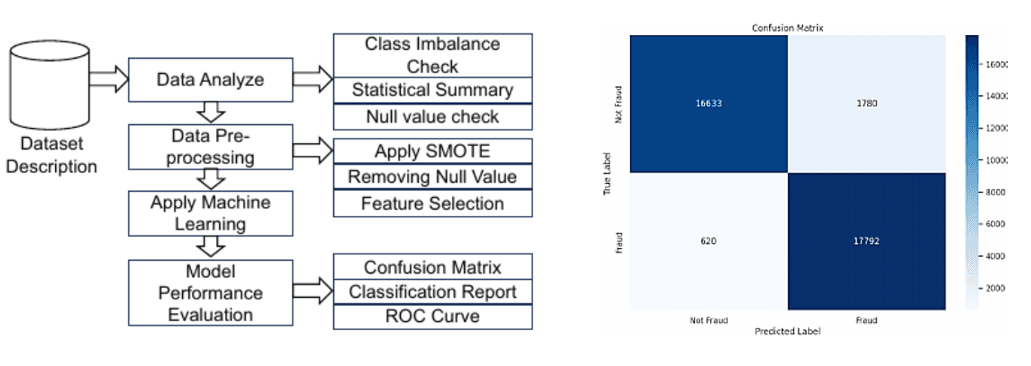
This research investigates the use of machine learning algorithms, such as the Random Forest Classifier, in the development of predictive models for the detection of credit card fraud. The model improves on previous attempts through the combination of secured datasets of anonymized transaction records and a variety of features such as average transaction volume and frequency patterns. The model was built and tested in a dataset that had unbalanced classes where the number of money-related transactions was significantly greater than that of fraudulent transactions. The model’s predictive power was boosted by incorporating synthetic oversampling through SMOTE and other advanced preprocessing methods with AUC-ROC statistics of 0.95 being recorded. It also achieves an accuracy of 0.93 and an F1 score of 0.93 indicating strong performance of accurately distinguishing between genuine and distorted transactions.
Publication Url
Tomato Leaf Disease Classification with Transfer Learning
A hybrid deep learning-based architecture is established including a Convolutional Neural Network (CNN) with attention mechanisms (Squeeze and Excitation, Spatial), residual connections, and transfer learning to classify and detect diseases in tomato leaves. This model demonstrates the potential of channel and spatial attention to identify irregularities in leaves, as proven through its 99.69% accuracy in the Plant Village tomato leaf dataset. This innovative method enables the development of solutions that are more reliable and simplified, which could be advantageous to both producers and agricultural practitioners in the future.
Accepted and Presented in Conference, will be available online soon