Digital Logic Design
Digital Logic Design is a foundational concept in ECE, focusing on the design and analysis of digital systems. These systems operate using binary or hex to process and represent information. Digital logic is essential for creating devices ranging from simple calculators to complex computing systems.
This course covers topics such as:
- Boolean algebra, Logic gates
- Binary codes, Error correcting codes
- K-map, don't care, SOP, POS
- Combinational Circuit design, MUX-DEMUX, Encoder-decoder, Adders
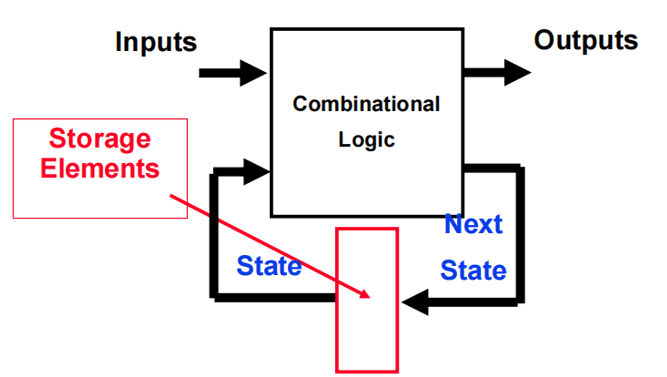
- Clocked sequential circuit design, Latch, flip-flop, Counters, Registers
- Memory, RAM, ROM, PLA, PAL
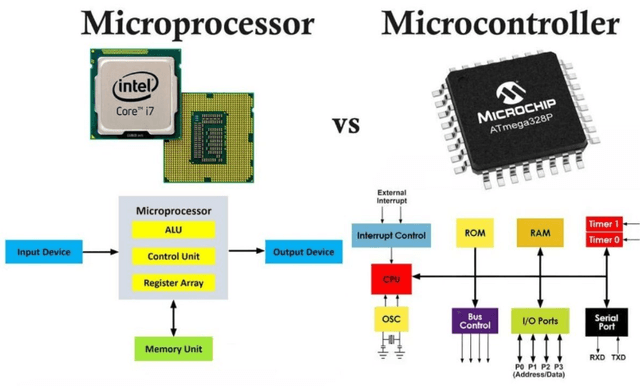
Microprocessor, Microcontroller and Embedded System
The 8086 microprocessor employs a segmented memory architecture, dividing memory into segments (Code, Data, Stack, and Extra). Each segment is addressed using a segment register and an offset, enabling efficient memory management. It supports pipelining, where instruction fetching, decoding, and execution occur in parallel, improving performance.
The 8051 is often referred to as a System on a Chip (SoC) because it integrates several components into a single chip, including a CPU, memory, I/O ports, timers, and more. Its notable features are Memory, timers, I/O Ports, Serial Communication, Interrupts, Oscillator
This course covers the followings:
- 8086 microprocessor evolution, architecture, and programming
- Memory segmentation, physical address
- Registers, flags, addressing, logic and arithmatic operations
- 8051 Microcontroller, I/O interfacing, IOT, Embedded System